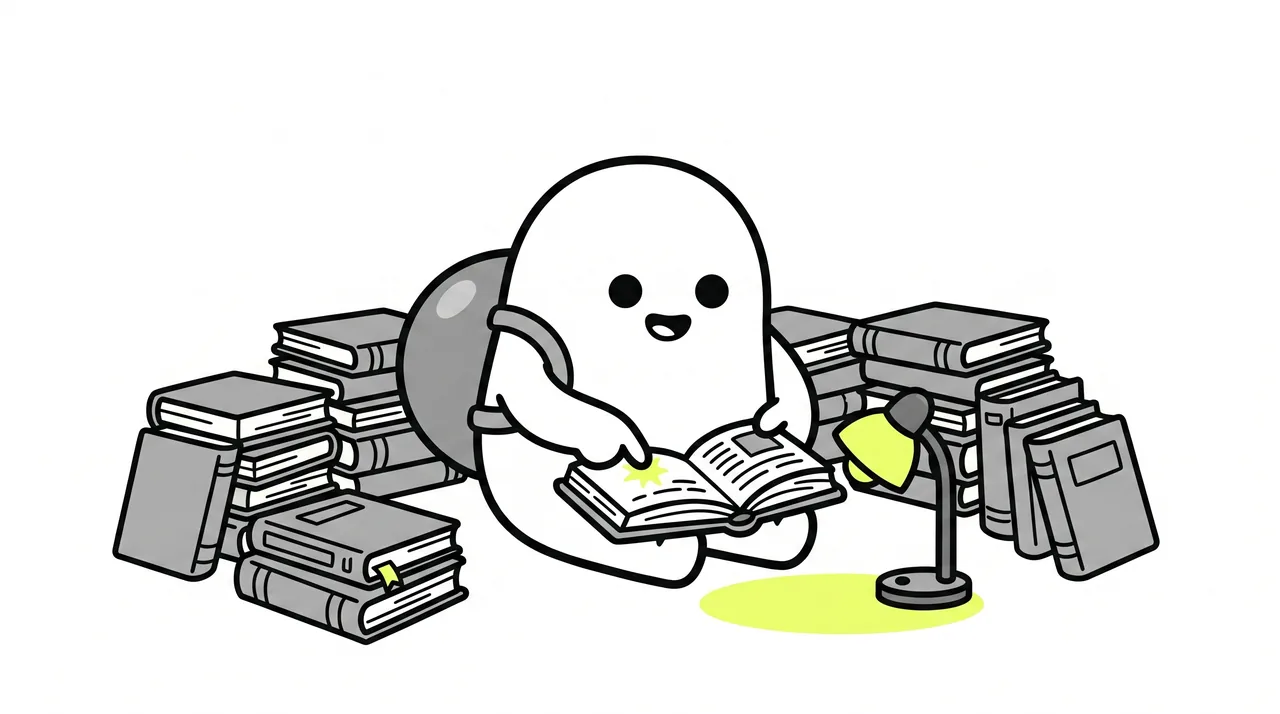
The books are read. The podcasts are listened to. There is an app for the mood tracking and a folder of saved posts you mean to go back through. And you still do not know which of it is actually for you, or where to put your attention first. More information did not make the next step clearer. It made it harder to see at all.
More choice, less starting
There is a famous study on this. Researchers set up a table in a supermarket, one day with 24 different jams to try, another day with 6. More people stopped to look at the 24. Far fewer of them actually bought one. With only 6 jams on the table, far more people walked away with a jar (Iyengar and Lepper, Journal of Personality and Social Psychology, 2000). More options drew the crowd, and the crowd mostly left empty-handed.
Working out what is wrong with you is the same table, except the jars are therapy, books, podcasts, courses, coaches, apps, and whatever you half-remember from a video last week. Every option looks reasonable. None of them stands out enough to actually pick. So nothing gets picked, and you stay standing at the table.
Why "just one more book" makes it harder, not easier
One of the more startling findings in this area came from watching parole board judges across a working day. Early in the morning, they granted parole in roughly two out of three cases. By just before a break, that had fallen close to zero. After the break, it jumped straight back up to about two in three (Danziger, Levav and Avnaim-Pesso, Proceedings of the National Academy of Sciences, 2011). Nothing about the cases changed through the morning. What changed was how many decisions, large and small, the judges had already made before reaching that one.
Reading another book, comparing two more approaches, weighing up a podcast recommendation: each one feels like preparation, not a decision. It is still a decision. By the time you reach the one that actually matters, what to do next, and starting doing it, there is often nothing left to make it with. This general pattern has a name, the paradox of choice (Schwartz, 2004): past a point, more input does not clarify a choice. It spends the resource the choice needed.
What you are actually looking for
Not another explanation. Most people who reach this point already understand their own pattern completely. What they are missing is not information, it is the thing that actually moves what the information cannot touch. So before anything else, it is worth asking plainly: if something really changed, what would be different. Not in general. One specific thing, this month.
Maybe the last thing you tried did help, for a while, and then it quietly wore off. That is not proof that nothing works on you. It is usually proof that you found something that worked on the symptom, and have not yet found the thing underneath it.
The routes, laid out honestly
None of these are wrong, and none of them compete with each other.
Therapy helps you understand a pattern, process what happened, and support your mental health. For a lot of people, it is exactly the right place to start, and for some of what it does, nothing else is the right substitute.
Books, podcasts and courses hand you language and ideas. They are often where the first real recognition happens: "that is me" on a page somewhere. They rarely move the thing itself, because understanding a pattern and being free of it are not the same skill.
Coaching, the goals-and-accountability kind, is built for direction: what you are moving toward, and who checks in on whether you moved. It assumes the block in your way is logistics. Sometimes it is.
Neurocoaching, which is what I do, picks up where the others stop: when you already understand the pattern, you can already explain it to anyone who asks, and it still runs anyway. That gap, between understanding something and being free of it, is the whole reason this exists.
Who this is for, and who it is not
This is for people who have already done the understanding. You could explain your own pattern to a stranger, in detail, and it still ran the last time it mattered. That is the exact gap this closes.
This is not for a first step if you are still working out what is actually wrong, and it is genuinely not for a crisis. If today feels like too much, your GP, a mental health professional, or Samaritans on 116 123 comes first, every time, no exceptions.
Where this leaves you
You do not need to read one more thing before you are allowed to start. You need the one route built for exactly where you already are: understanding it completely, and still carrying it anyway. If that is you, how it works is the plain next page, and the complimentary mini course is a first look that costs nothing.
References
Iyengar, S. S. and Lepper, M. R. (2000). When choice is demotivating: can one desire too much of a good thing? Journal of Personality and Social Psychology, 79(6). · Danziger, S., Levav, J. and Avnaim-Pesso, L. (2011). Extraneous factors in judicial decisions. Proceedings of the National Academy of Sciences, 108(17). · Schwartz, B. (2004). The Paradox of Choice: Why More Is Less. Harper Perennial.