Too Much Advice: Where to Start When You Have Read Everything
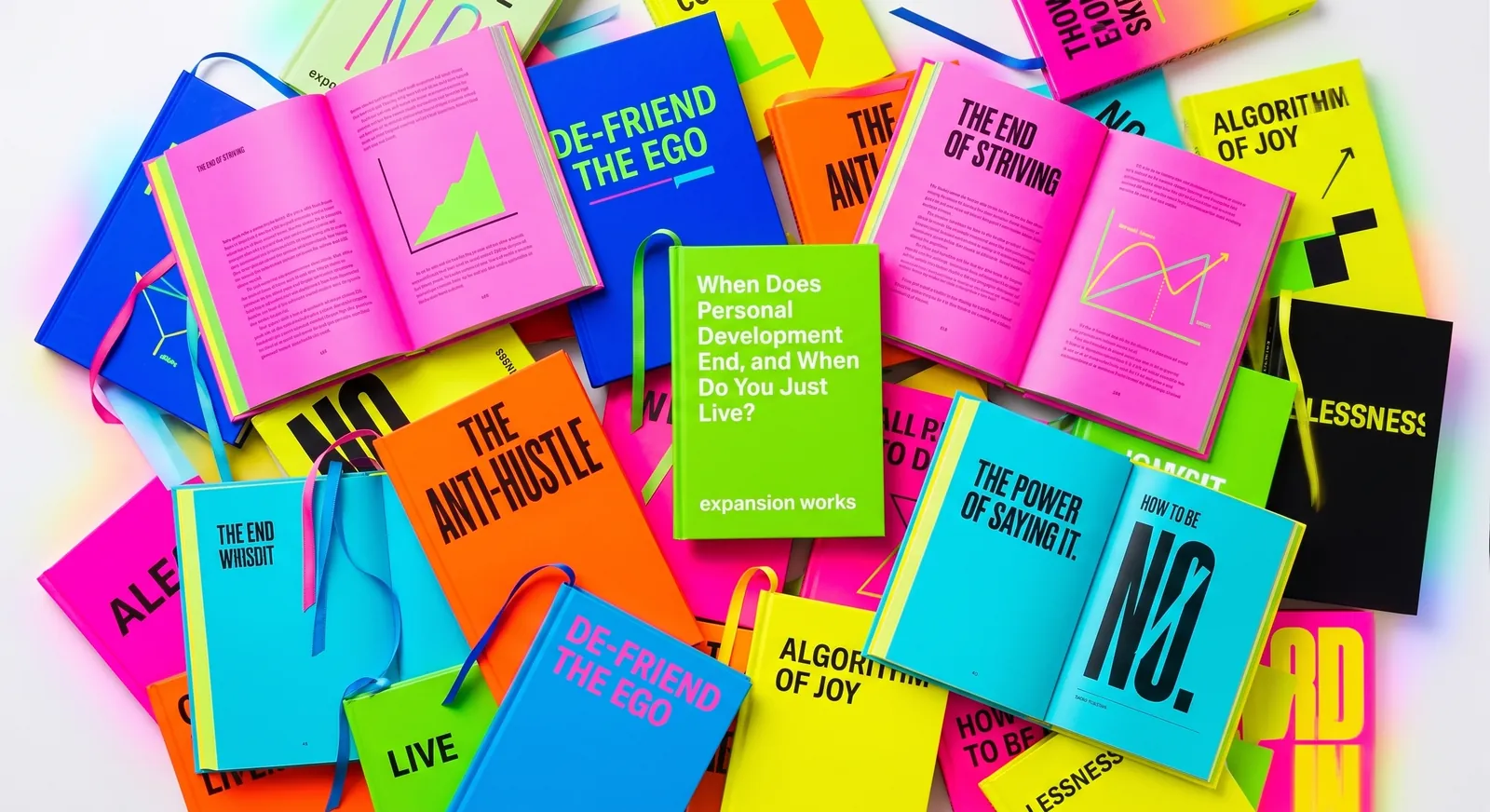
I have read them too. The books, the courses, the frameworks with three steps and the ones with twelve. I work inside this industry, and some weeks I still cannot digest the volume of it. Everyone has an opinion. Most of them are selling something. And if you have been at this a while, you will know the feeling of finishing another book and being no closer to knowing what to actually do.
That is not a flaw in you. It is what happens when a whole industry writes for everyone at once. So let me do the opposite, and write this for one person: you, with a shelf full of advice, wanting one honest place to start.
If you only read one paragraph, read this one. There are four routes through this work, and they are for different jobs. Talk it through, for understanding. Think differently, for catching a thought while it happens. Do more, for when you know what to do and are not doing it. Go underneath, for when you understand the pattern completely and it still runs the show. The way to choose is one question: what do you actually want to be different, and have you already tried thinking your way there? The rest of this piece is that answer, slowly.
Why it feels like this
There is a reason the shelf makes you feel worse the fuller it gets, and it is not a lack of discipline. Researchers who study how people choose found that having more options only becomes a burden under particular conditions: when the options are hard to compare, when you are not sure what you prefer, and when you are trying to pick one rather than simply browse (Chernev, Böckenholt and Goodman, Journal of Consumer Psychology, 2015). Read that list again. Hard to compare, unsure what you want, and needing to choose. That is the self-help shelf exactly. The overload is a property of the shelf, not of the person standing in front of it.
The other reason is quieter. Most advice is written for everyone, which means it is written for no one. A book cannot know what you are carrying. So it hands you a method and hopes. Some of those methods are good. Very few of them are matched to the thing actually in your way, because the author has never met you.
The four routes, laid out plainly
Here they are without a ranking, because there is not one. Each has a job it is good at, and a job it is not built for. I have used all four myself, and I would not talk anyone out of any of them.
Talk it through. Therapy, counselling, the honest conversation with someone trained to hold it. This is for understanding: for history, for grief, for anything that feels clinical or heavy, and for anyone in a bad place. If things are heavy right now, this is the first door, not the last. What it will not always do is move a pattern you already understand perfectly well, because understanding and changing are different jobs.
Think differently. CBT, mindset work, journaling, affirmations, the reframe. This is for catching a thought while it is happening and choosing a different one. It works best when the thing in the way is a thought. What it will not do is reach something that sits underneath thinking, because you cannot out-think a belief that was never a thought in the first place.
Do more. Habits, discipline, accountability, coaching for the mechanics of a life. This is for when you know exactly what to do and you are not doing it, and you need structure and someone to answer to. What it will not do is explain why you keep not doing it, and it can turn into pushing against yourself, which is exhausting and rarely lasts.
Go underneath. Work that clears the charge at the source, where the pattern was learned. This is for when you have understood the pattern fully, reframed it, built the habit, and it still runs the show. It is what I do, and I will say plainly that it is a different job from the other three, not a better one. You bring your focus to one thing, and your own mind does the rest: it finds every part of us that learned this, and helps them set the weight down. What it will not do is replace therapy for anything clinical, and it will not tell you your history. It is not built to.
The sorting question
Two questions, really, and they are yours to answer, not mine.
First: what do you actually want to be different? Not in general. One thing. The meeting you dread, the message you never send, the evening that always ends the same way. Name it, because every route works better with one thing in front of it.
Second: have you already tried thinking your way there? If you have not, start with thinking. It is the cheapest route, it is often enough, and it costs you nothing but attention. A good book, a journal, a reframe. Give it an honest go.
If you have, and it has not moved, that is the tell. Not that you did it wrong, and not that what you tried was wrong. It is the tell that the thing in your way is not a thought, and thinking cannot reach it. That is the point where the fourth route becomes worth a look, and it is the only point where I would suggest it.
Who this route is for, and who it is not for
Stated as fit, because that is all it is. The fourth route is for people who have done the work already, who can name the pattern, and who are ready to set something down rather than understand it further. It suits the ones everyone else leans on, who are more self-aware than most people they know and still meeting the same block.
It is not for anyone in crisis. If that is you, your GP or a qualified mental health professional comes first, and the Samaritans are on 116 123, any hour. It is not a replacement for therapy, and plenty of people do both. And it is not for anyone who wants to be told what is wrong with them, because nothing here will do that. You decide what you are ready to let go of. Your mind decides how, and when.
Where this leaves you
You do not need another book. You need one honest answer to one honest question, and then one door. If the thing in your way is a thought, think. If it is heavy, talk. If you know what to do and are not doing it, build the structure. And if you have done all of that and it still has not moved, come and see why. Whichever you choose, you are not behind. You are a person with a shelf full of advice who is about to stop reading and start.
If you have landed on "a coach" as the answer and want to choose well, the honest guide to choosing a coach is written for exactly that. If your question is less "where do I start" and more "when does this end", that one has its own piece. And if you would rather meet the thing underneath before deciding anything, the You Are Not Broken workbook is a gentle, free place to begin, in your own time.
Whenever you are ready, the door is open.
Start with the workbookReferences
Chernev, A., Böckenholt, U. and Goodman, J. (2015). Choice overload: A conceptual review and meta-analysis. Journal of Consumer Psychology, 25(2), 333–358. The effect is contingent, not universal: it appears with complex choice sets, difficult decisions, uncertain preferences and a goal of choosing rather than browsing. · Everything else in this piece is personal experience, labelled as such, and held lightly.
A note before you go: articles like this are shared for education and reflection. They are not medical or psychological advice, and they are never a replacement for working with a qualified professional when you need one. And we hold the science here the way we hold everything: as our best current way of seeing, a lens rather than the last word. It keeps learning, and so do we.