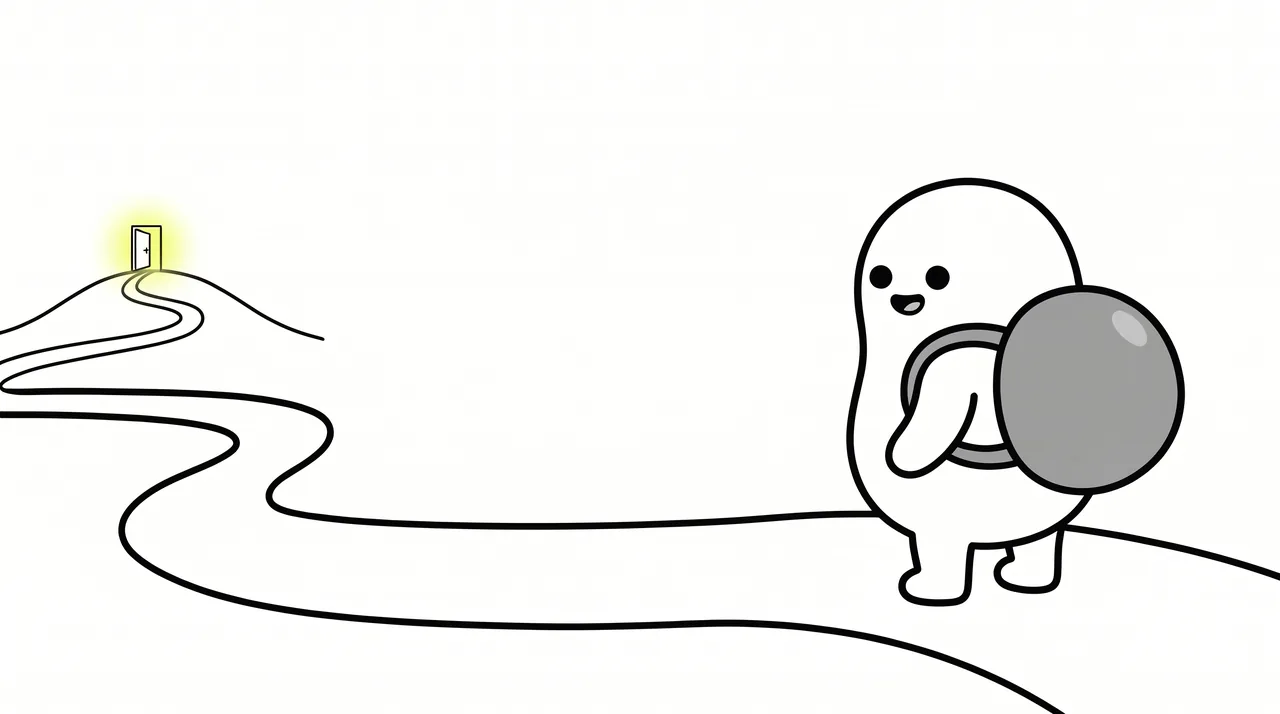
Week one, you are all in. Week three, the course sits half-finished, the gym kit stops moving from the same shelf, the plan quietly stops being mentioned. Nothing dramatic happened. You just stopped. And afterwards comes the question that stings more than the stopping itself: why can I not just finish the thing I actually wanted?
Here is the short answer: it is not that you want it less by week three than you did on day one. It is that your mind is running a quick, rough calculation between relief right now and a result still some distance away, and in that calculation, later rarely wins on its own.
It is not a willpower problem
The story most people tell themselves here is harsh: I am lazy, I lack discipline, I do not want it enough. None of those hold up, because the same person who "lacks discipline" started the thing in the first place, often more than once. Laziness does not keep returning to something it does not care about.
One of the largest reviews of procrastination research ever done, covering over two hundred studies, found something plainer: procrastination tracks far more closely with how a task feels right now than with how much you actually want the outcome (Steel, Psychological Bulletin, 2007). The gap is not between wanting and not wanting. It is between wanting the result and dreading the doing.
Jez D, a consultant who came to a session with exactly this knot, put it plainly in their own testimonial: "My increasing frustration at why I couldn't get on with my creative projects was magnifying itself daily, and getting in my way. At a time when I've got far worse things to deal with than honouring my creative work, it made no sense that I couldn't just do it." (Jez D · Consultant, testimonial). That is not someone short on discipline. That is someone who, like most people here, could see exactly what they wanted and still could not make themselves move toward it.
The maths your brain is quietly doing
There is a reason the pull to stop is strongest right at the moment you are about to do the hard part, and almost never before. Behavioural researchers call it hyperbolic discounting: every reward you are weighing up gets mentally discounted the further away it sits in time, and that discount does not fall in a straight line. It drops steeply the closer you get to the present moment (Ainslie, Psychological Bulletin, 1975). A result worth having in a few months barely registers against discomfort sitting in front of you right now. You are not failing to want the result. Your mind is doing the sums on now versus later with a calculator that is quietly rigged in favour of now.
That also explains why the stopping point is so predictable. It rarely happens in week one, when the goal still feels close and the novelty is doing some of the work. It happens in week three, roughly where the gap between how it feels right now and how it will feel once it is finished is at its widest. The maths gets worse at exactly the point you need it to hold.
What is actually happening when you stop
Researchers who study this closely describe procrastination as a kind of short-term mood repair: putting the task off trades the discomfort it brings up right now for relief right now, even though it costs the future version of you more (Sirois and Pychyl, Social and Personality Psychology Compass, 2013). Put plainly: stopping is not nothing happening. It is a part of you choosing relief over discomfort, in the moment, every time that choice comes up.
That part is not working against you. It learned, somewhere, that the discomfort attached to continuing was not safe to sit with. So it does the only thing it knows how to do about that: it pulls you out.
The part doing the stopping
A part of you, in the human sense: a younger you who learned, at some point, that stopping felt safer than whatever continuing was about to bring up. Being seen finishing. Being judged on the result. Finding out the thing still was not enough. You do not beat that part into compliance. You help it feel safe enough to let the discomfort move, so it stops needing to pull the plug.
It often shows up small and ordinary, not dramatic. You wake up and spend the first ten minutes of the day deciding, again, what today is even for, long before you get anywhere near the thing you stopped. That is not scatter. That is the same part, still checking whether it is safe to go back in.
What actually shifts it
Not more accountability bolted on from outside, and not a harder version of the same plan. The shift comes from finding what continuing was actually bringing up for you, and clearing the charge attached to it, so the task itself stops feeling like the thing to escape. That is the work a neurocoaching session does. One client's own words on what held when the pattern underneath it moved: it became "ingrained," he said, "helping me break through resistance and move from insight into genuine, sustainable change" (Piers Y, public review).
Jez named the same shift in their own terms, from the same testimonial: "My resistance at the start was 10/10, if not 12/10. After an hour, more like 2/10." (Jez D · Consultant, testimonial). Not motivation arriving from nowhere. The resistance itself, quieting down.
One more thing worth knowing, for whenever you do start again: the day does not have to be neutral. People are measurably more likely to act on a goal right after what researchers call a temporal landmark, a Monday, the first of the month, a birthday, because it gives the mind permission to draw a line under the last attempt rather than count it as more evidence against you (Dai, Milkman and Riis, Management Science, 2014). Picking a fresh-start date is not a trick. It is working with how your own mind already keeps score.
And then you act, same as always. Clearing the resistance was never the same as doing the thing. The doing stays yours, which is the part that was always going to feel good when it finally happened.
Where this leaves you
If you keep starting and keep stopping, be gentler with the person who keeps starting. Something in you still believes in the thing enough to begin it. Something else in you has been deciding, every time, that stopping is the safer move. Clear that, and starting stops being the hard part. If you want to see what is behind your own stopping point, the complimentary mini course was built for that first look.
References
Steel, P. (2007). The nature of procrastination: a meta-analytic and theoretical review of quintessential self-regulatory failure. Psychological Bulletin, 133(1). · Sirois, F. M. and Pychyl, T. (2013). Procrastination and the priority of short-term mood regulation: consequences for future self. Social and Personality Psychology Compass, 7(2). · Ainslie, G. (1975). Specious reward: a behavioral theory of impulsiveness and impulse control. Psychological Bulletin, 82(4). · Dai, H., Milkman, K. L. and Riis, J. (2014). The fresh start effect: temporal landmarks motivate aspirational behavior. Management Science, 60(10).