Every January you will be bombarded: a new planner, a new app, a thirty-day challenge, a podcast telling you this is the year. You have probably tried a lot of them already. So had I. So this article keeps it simple: what trips us up, and what to do about it.
Here is the short answer. New Year's resolutions rarely stall because the plan was wrong, or because you lack willpower. They stall because a part of us learned, long ago, that the change we want is not safe to have yet. That part pulls the brake in the second or third week of January, right on time.
People who come to expansion works® describe it in their own words like this:
“I have many great ideas and act on almost none of them.”
“Trying to rid myself of repeating patterns that I am aware of, but find myself in a loop.”
If that sounds like your January, read on.
Why do most New Year's resolutions fail?
Fewer fail than the headlines say, and the ones that do fail early. In one of the best-known studies, a psychologist followed 200 people through their resolutions. After a week, three in four were still going. After a month, just over half. Two years on, about one in five.
Closer to home, the picture is kinder than you might expect. Of the people in the UK who made resolutions for 2025, more than a third say they kept all of them, and another third kept some (YouGov).
So the drop happens in the first month. When the same researchers looked at who kept going past it, three things made the difference: being ready to change, believing you could do it, and knowing how. Notice the middle one. Believing you can do it is a belief, and beliefs are where this article is heading.
What is Quitter's Day, and when is it?
In 2019 the exercise app Strava looked at more than 108 million activities logged in the US and found the point by which people were most likely to have given up a fitness resolution. It named 17 January “Quitter's Day”. Many papers now mark Quitter's Day on the second Friday of January. In 2027 that is Friday 8 January.
The timing is not random. By the second week, the excitement of starting has worn off, and the result still feels a long way away. That gap is where a part of us that is unsure about the change gets its say.
The four mistakes that trip us up every January
1. Buying a new plan for an old pattern
When a resolution stalls, the reflex is to find a better system: a new app, a stricter routine, another course. If the plan was the problem, the second plan would work. For many people, the second plan stalls in the same week, in the same way. That is the clue that the plan was never the problem. Underneath every plan sits something deeper: a part of you holding resistance to the change itself. A new plan does not reach it.
2. Setting the goal as something to stop
“Stop scrolling.” “Stop eating sugar.” “Stop putting it off.” A Swedish study of more than a thousand people found that goals to move toward something did better a year later than goals to stop something. Their example: “I will eat fruit several times a day” in place of cutting out sweets. Here is my hot take on why: a goal written as a stop keeps your attention on the thing you are trying to leave. It also sets you up to fight a part of you that is only doing the job it learned. The harder you push, the harder that part pushes back.
So turn it round, and write it as if you have already done it: “I write for twenty minutes before work.” Your brain handles an imagined moment in many of the same ways as a real one. Scientists describe picturing something as working like a weak form of actually seeing it.
The research adds one thing worth knowing: picturing it done is only the first half. In one set of studies, people who only daydreamed about the finished result had less energy and got less done that week. What helps is picturing it done, then noticing what gets in the way. Across 21 studies and nearly 16,000 people, that combination helped people reach their goals. What gets in the way is usually a part of you, and that is exactly what the rating further down is for.
3. Researching until you are overwhelmed
One person put it to us like this: “I'd stop procrastinating and 'researching' so much that I get overwhelmed and don't take action.”
Researching feels like progress. Every new option is another decision, and every decision between you and the first step is another place to stop. And every extra option wakes up another part of you: the one that says “I don't even know where to start”, and the one that has already decided you could never pull it off. Choosing one goal, and one first step, is often the hardest and most useful thing you do all January. If this is you, where to start when you have read everything goes deeper.
4. Calling it a willpower problem
Research on procrastination keeps finding the same thing: putting something off has far more to do with how the task feels right now than with how much you want the result. Putting it off swaps the discomfort of doing it for relief, right now, even though it costs you later.
So here is my hot take: willpower is the wrong tool for this job. Call it a willpower problem, and the fix becomes “try harder”. Trying harder is what you did last January. Willpower is one part of you trying to overpower another, and the part being overpowered does not give up its job.
What all four mistakes have in common
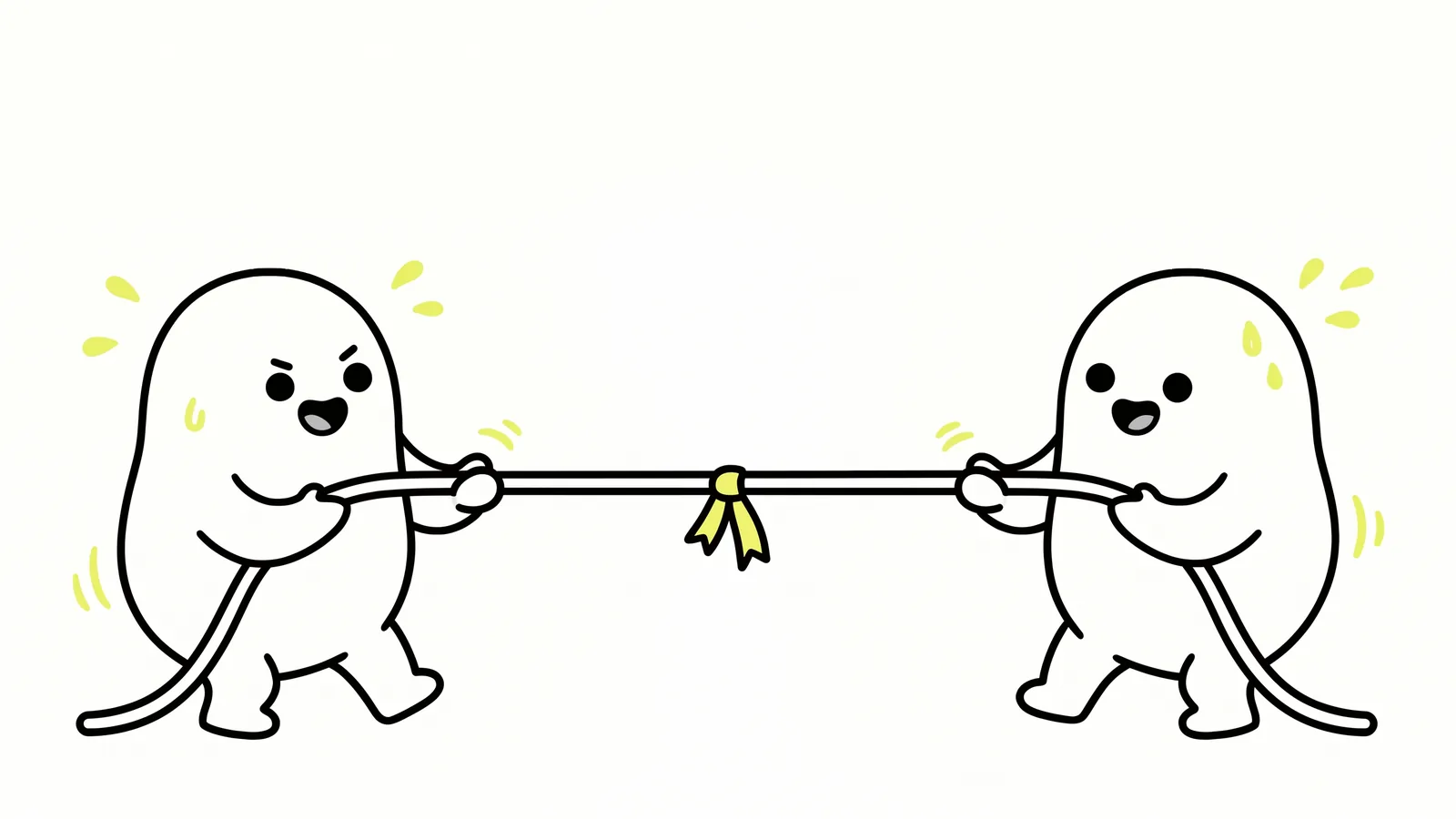
Look at the four together and the same thing sits underneath each one. A new plan, a goal to stop, more research, more willpower: each one asks you to push harder against a part of you that is trying to keep you safe. Every push creates more resistance.
There is another way. We do not fight those parts. Your own mind can update what they learned, so they work with you rather than against you. When those parts are in alignment, you can set the goal and get on with it.
Why does knowing exactly what to do still not work?
By now you could probably write the advice yourself: make it specific, start small, track it, tell a friend. None of it is wrong. It works on the plan. The reason you stop sits underneath the plan.
This is where the parts come in. Each one is still doing the job it took on, and January, with its big promises, is when they get busy. The result looks like self-sabotage. It is protection with bad timing.
Jez D, a consultant who came to a session with exactly this, wrote in their testimonial: “At a time when I've got far worse things to deal with than honouring my creative work, it made no sense that I couldn't just do it.” (Jez D · Consultant, testimonial). Knowing what to do was never Jez's problem. In the same testimonial, Jez wrote about one session: “My resistance at the start was 10/10, if not 12/10. After an hour, more like 2/10.”
A simpler way to set a goal this January
Here it is, broken down:
- Pick one goal that comes from your heart. Ask yourself: would I still want this if nobody ever knew I had done it? If the answer is no, it may be a goal you think you should have, rather than one you want.
- Write it as if you have already done it. “I write for twenty minutes before work”, in place of “I will stop scrolling in the morning”.
- Picture it already done, then rate how strong the resistance feels. 0 is completely neutral. 10 is a high level of intensity. Notice where you feel it: a tight chest, a clenched jaw, a sudden urge to check your phone. That feeling is the part of you that is not on board yet.
- If the number is high, clear the resistance before you plan. That is what a neurocoaching session is for. You bring one moment to mind, and your own mind finds everything connected to it and clears it. Then you rate the same moment again, and see what changed.
- Take the first step on a date that means something to you. People are more likely to act on a goal straight after a fresh start: a Monday, the first of the month, a birthday, or 1 January. You do not have to wait for January. Next Monday works too.
Where this leaves you
If you have set the same resolution more than once, something in you still wants it. Something else in you has been pulling the brake, every January, right on time. Clear what that part is holding, and the plan you already know how to make gets a real chance to work.
If procrastination is the pattern you know best, the Procrastination session is a recorded session you can play today, in your own time. It is on the on-demand page, as a bonus with Clearing One and Two.
References
Dai, H., Milkman, K. L. and Riis, J. (2014). The fresh start effect: temporal landmarks motivate aspirational behavior. Management Science, 60(10). · Norcross, J. C. and Vangarelli, D. J. (1989). The resolution solution: longitudinal examination of New Year's change attempts. Journal of Substance Abuse, 1(2). · Norcross, J. C., Mrykalo, M. S. and Blagys, M. D. (2002). Auld lang syne: success predictors, change processes, and self-reported outcomes of New Year's resolvers and nonresolvers. Journal of Clinical Psychology, 58(4). · Kappes, H. B. and Oettingen, G. (2011). Positive fantasies about idealized futures sap energy. Journal of Experimental Social Psychology, 47(4), 719–729. · Pearson, J., Naselaris, T., Holmes, E. A. and Kosslyn, S. M. (2015). Mental imagery: functional mechanisms and clinical applications. Trends in Cognitive Sciences, 19(10). · Schwartz, R. C. (1995). Internal Family Systems Therapy. Guilford Press. · Oscarsson, M., Carlbring, P., Andersson, G. and Rozental, A. (2020). A large-scale experiment on New Year's resolutions: approach-oriented goals are more successful than avoidance-oriented goals. PLOS ONE, 15(12), e0234097. · Sirois, F. M. and Pychyl, T. (2013). Procrastination and the priority of short-term mood regulation: consequences for future self. Social and Personality Psychology Compass, 7(2). · Steel, P. (2007). The nature of procrastination: a meta-analytic and theoretical review of quintessential self-regulatory failure. Psychological Bulletin, 133(1). · Strava (2019), as reported by GearJunkie, 17 January 2019. · Wang, G., Wang, Y. and Gai, X. (2021). A meta-analysis of the effects of mental contrasting with implementation intentions on goal attainment. Frontiers in Psychology, 12, 565202. · YouGov (17 December 2025). What New Year's resolutions are Britons making for 2026?